Skip to content Skip to footer

ARI BAYUAJI

Works           Info          

Ari Bayuaji

BACKGROUND

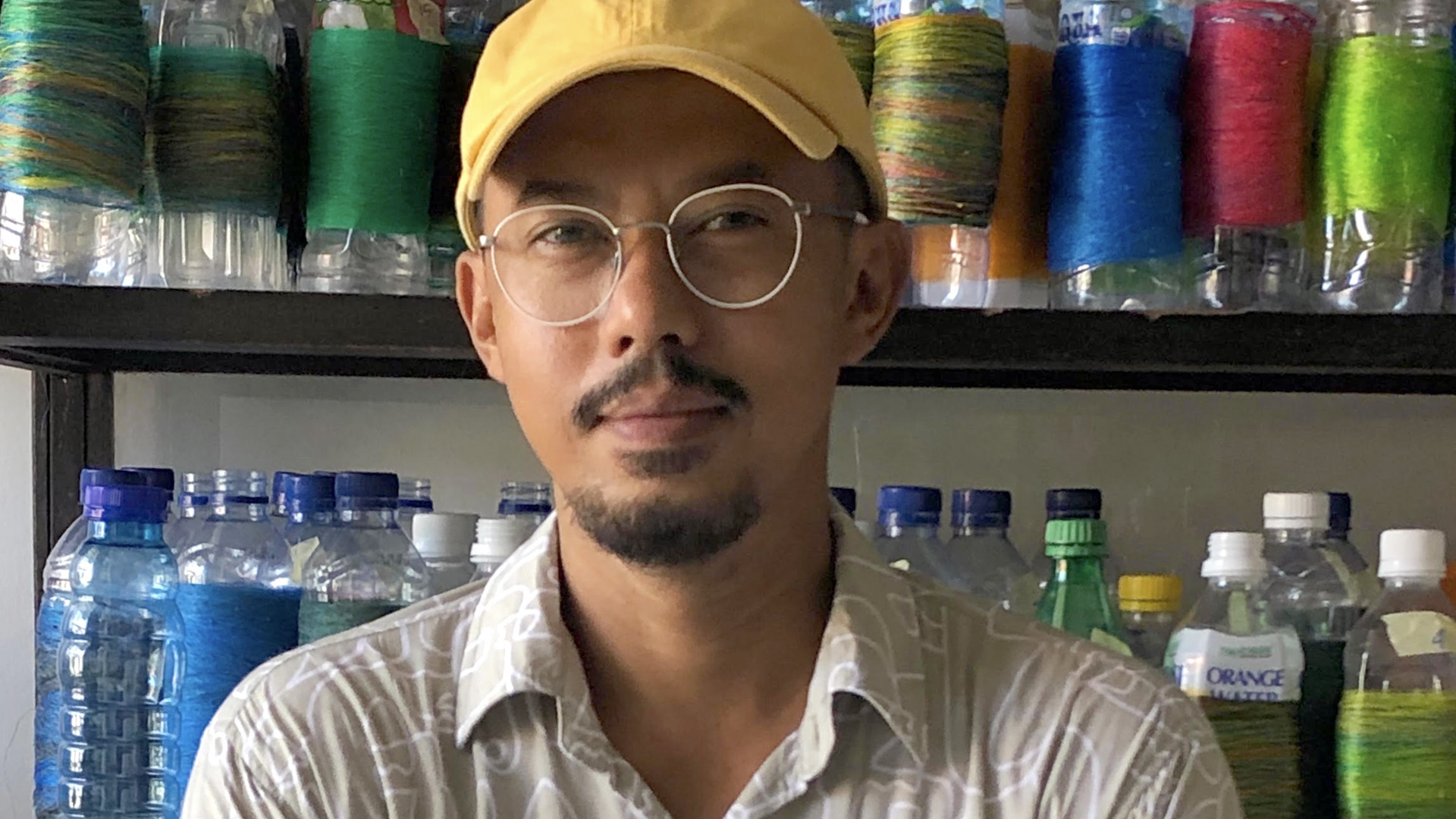
Ari Bayuaji is a Canadian artist of Indonesian origin. Through sculptures, textile works and installations incorporating found objects or materials, he explores the theme of cultural identity and offers a critical reflection on the complexities of our globalised existence. Bayuaji is distinguished by the particular attention he pays to materials and by his ability to create a dialogue between traditional craftsmanship – inspired by his deep connection to Indonesia’s cultural history – and current issues of universal significance. Bayuaji’s practice thus transcends geographical and cultural boundaries, making it particularly relevant in today’s diverse social context.

Beyond the messages they convey, Bayuaji’s works stand out for their concrete and lasting commitment to the contemporary social and environmental issues they address. His project Weaving the Ocean, launched in 2020 with support from the Canada Council for the Arts’ Explore and Create programme, is a powerful testament to this. In collaboration with a traditional Balinese weaving workshop, Bayuaji transforms plastic ropes washed up on the shore into tapestries that celebrate Indonesian textile culture and provide financial support to artisans and local economies affected by the pandemic. The aesthetic quality of these works carries an undeniable political dimension, reminding us that what is discarded – whether materials or stories – can be reclaimed and transformed. 

His works form part of the permanent collections of the Montreal Museum of Fine Arts, the Musée national des beaux-arts du Québec, the Montreal Museum of Contemporary Art, the Pointe-à-Callière Museum and Global Affairs Canada. While Ari Bayuaji’s practice has been recognised in Quebec and Canada for several years – notably through his participation in the Baie-Saint-Paul Symposium (2018) and a residency at the Montreal Museum of Fine Arts (2016) – the Weaving the Ocean project has sparked increased interest in his work. This recognition is reflected in several significant achievements, including the solo exhibition Weaving the Ocean: in Ari Bayuaji’s studio, presented at the Espace pour la vie at the Montreal Biosphere from 2023 to 2025, as well as the acquisition of a major work by the Montreal Museum of Contemporary Art, currently on display in the group exhibition Comfort and Indifference at the Montreal Museum of Fine Arts. His solo exhibition Ocean of Beads will open in June 2026 at the Musée d’art contemporain de Baie-Saint-Paul.

Interest in Ari Bayuaji’s work extends far beyond Canada. He has already held major solo exhibitions in Singapore, Taipei (Taiwan), Sainte-Alvère (France), Düsseldorf (Germany), Rotterdam (Netherlands), Sydney (Australia), Bangkok (Thailand), Washington D.C. (United States) and Yogyakarta (Indonesia). Thanks to his Weaving the Ocean project, he is currently enjoying unprecedented international attention in his career, with a series of major solo exhibitions showcasing installations from this project, notably at the Centre for Heritage, Arts and Textile (Hong Kong, China), at Go for Kogei 2025 (Toyama, Japan), at Roppongi Art Night 2025 presented by the Mori Art Museum (Tokyo, Japan), and at the Prince Takamado Gallery at the Canadian Embassy in Tokyo (Japan). Two of the artist’s large-scale textile works were selected for the group exhibition The Duality of Everyday Life / Focus on Textile Expression at the Kyoto National Museum of Modern Art, and he was invited to present an installation at Art Basel Hong Kong 2026 in the Encounters section, curated by Mami Kataoka, director of the Mori Art Museum (Tokyo).

For more information, consult Ari´s website and his Instagram.

ARI´S DO PICHO PROJECT

We acknowledge the support of the Canada Council for the Arts.

This artist residency will focus on creating art by using the challenges of ocean pollution as inspiration, an approach that distinguishes my current artistic practice.

I have known Do Picho´s Founder, Ralf Jürgens, for more than 15 years, when I was a student in Studio Arts at Concordia University in Montreal and he was a human rights advocate with a keen interest in the arts. Since then, he has closely followed the creation and international resonance of my “Weaving the Ocean” project, which I developed in Bali, Indonesia, during the COVID-19 pandemic.

The artwork in the “Weaving the Ocean” series was inspired by discarded plastic fishing ropes which I had found tangled in the roots of the mangrove on the beaches at Sanur, Bali. I decided to use the ropes as material for my artistic work. When I dismantled the ropes, I discovered that they were made from a plethora of thin, coloured plastic threads which I then used as material for works of visual art. 

The context was important, too. When the pandemic hit, Bali’s economy collapsed, since no tourists could visit the island. This prompted me to include in my project community members who had lost their livelihoods. I began a collaboration with a traditional Balinese weaver and a traditional mask-maker, while also employing several local assistants. So, my project became an initiative of nurturing hope, building social solidarity, as well as recovering thousands of kilograms of plastic ropes from the beaches and mangroves.

The “Weaving the Ocean” project was developed in Bali, an island whose residents have endured the effects of climate change and plastic waste for many years. Much of Spain is also bordered by ocean and sea. For some time now, I have wanted to explore the resonance of my Bali project in other parts of the world and to address the ways in which other communities experience and respond to environmental changes.

There are examples of ocean pollution in Spain that are similar, yet distinct, from those seen in Bali. I draw inspiration from the specifics of local environments and materials and the ways in which they evoke contemporary challenges for societies. This is why I plan to conduct direct research during my residency at Do Picho on the nearby beaches of Galicia as a crucial first step in determining the state of local ocean and beach pollution and its impact on local environments and communities. This will enable me to discover the materials that could be available for the creation of my artwork.

The Do Picho residency programme has several features that make it uniquely suited for providing me with the space, support and community connections that can be particularly helpful for me at this stage of my artistic career. Most importantly, the residency has a strong focus on the environment and on human rights more broadly. 

In exploratory conversations with Ralf Jürgens, it was clear that I would receive strong support that is rooted in a keen awareness of the issues I have been grappling with artistically throughout my career. There is also a commitment to facilitate my working with the local community and making meaningful connections with the local and regional artistic scene. This residency will therefore provide me with both the space and time for introspection and inspiration and the creation of new works in a new environment.

The residency at Do Picho also presents opportunities to connect with galleries and artists in Galicia and elsewhere in Spain. In the past decade, my work has been exhibited in Asia, North America and Europe, and I have also participated in artist residencies in Singapore, Perth (Australia), Taipei (Taiwan), Rotterdam (Netherlands), St-Alvère (France) and, most recently, in Dusseldorf, Germany.

Each experience has fed my creative process and contributed to my artistic development. This residency is a wonderful opportunity to relate my “Weaving the Ocean” project to Europe, to a context outside Asia and the Pacific, and to discover and express its relationship with the ecological realities in this part of the world. 

Contact

Filgueira 30
27200 Palas de Rei
info@dopicho.com

+34 667 223 603

Donation

DO PICHO is a non-profit association. Support our artists, exhibitions and events with a  donation. To make a donation and receive further information regarding how you can support our activities: info@dopicho.com  

DOPICHO © 2026. ALL RIGHTS RESERVED.